
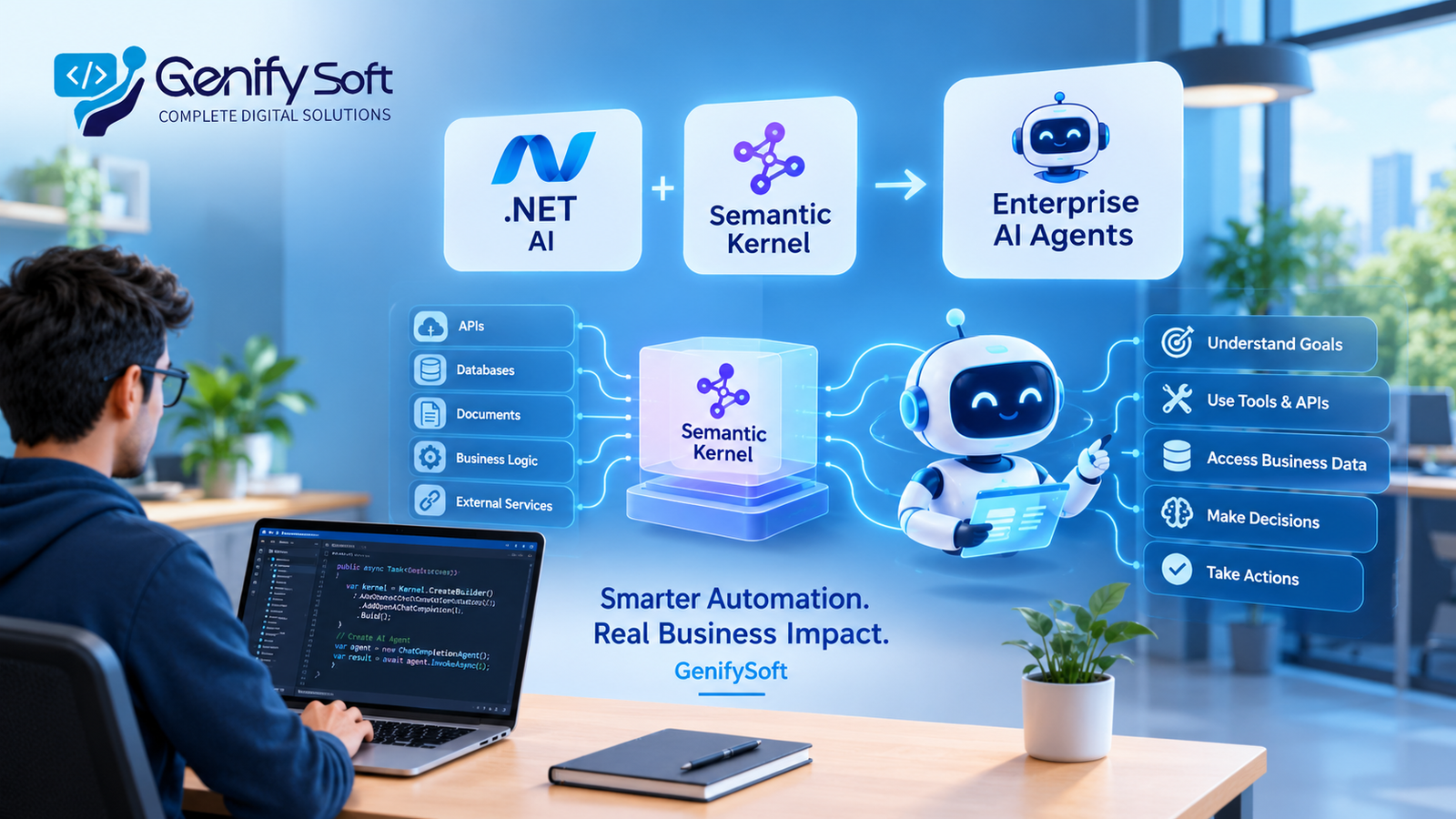
Artificial intelligence is moving beyond traditional chatbots and simple question-answering systems. Modern businesses need AI applications that can understand context, work with business data, use tools, interact with APIs, and complete complex tasks.
This is where enterprise AI agents are becoming increasingly valuable.
At GenifySoft, we use modern AI technologies to explore and develop practical solutions that can be integrated into real business applications. One technology that can play an important role in this approach is Microsoft Semantic Kernel, particularly when combined with .NET AI and existing enterprise software.
Semantic Kernel allows developers to connect AI models with application functions, plugins, APIs, data sources, and business logic. When combined with .NET, it provides a strong foundation for building AI-powered applications that can work within existing enterprise environments.
In this article, we explore how GenifySoft uses Semantic Kernel and .NET AI concepts to build enterprise AI agents, how these technologies work together, and where AI agents can provide value for modern businesses.
What Is Semantic Kernel?
Semantic Kernel is an open-source SDK from Microsoft designed to help developers integrate AI capabilities into applications.
It allows developers to connect AI models with application functionality instead of treating an AI model as an isolated chatbot.
For .NET developers, Semantic Kernel provides an approach for integrating AI into existing C# and .NET applications using familiar software development concepts.
The Semantic Kernel architecture can connect several components, including:
- AI models
- Application services
- Plugins
- Custom functions
- APIs
- Databases
- Business logic
- External services
- Enterprise data
This makes Semantic Kernel useful when an AI application needs to do more than generate text.
For example, an enterprise customer-support agent could receive a request from an employee and then:
- Understand the request.
- Identify the required business information.
- Search relevant data.
- Call an approved application function.
- Analyze the returned information.
- Generate an appropriate response.
- Escalate the request when human intervention is required.
This is the foundation of a more capable AI agent.
Microsoft Semantic Kernel Documentation
Why GenifySoft Uses Semantic Kernel With .NET AI
Many organizations already have applications built with Microsoft technologies and .NET.
They may have:
- ASP.NET Core applications
- REST APIs
- CRM systems
- ERP systems
- Internal business applications
- SQL databases
- Cloud services
- Authentication systems
- Existing business workflows
Replacing these systems simply to introduce AI is often unnecessary.
At GenifySoft, we see significant value in integrating AI capabilities into existing software architectures.
A typical architecture can look like:
User → .NET Application → Semantic Kernel → AI Model → Business Functions → Enterprise Data → Response
This approach allows AI to become part of the existing software ecosystem.
Rather than building an independent chatbot, we can develop AI capabilities that interact with the actual application.
For example, an AI assistant inside a CRM could help employees retrieve customer information, summarize interactions, analyze opportunities, or perform approved actions.
This is where Semantic Kernel and .NET AI become particularly useful for enterprise software development.
How Semantic Kernel Helps Build Enterprise AI Agents
An enterprise AI agent needs more than a language model.
It may need instructions, context, memory, tools, data access, business rules, and application functions.
Semantic Kernel provides building blocks that developers can use to connect these components.
AI Model Integration
The language model provides capabilities such as:
- Natural language understanding
- Text generation
- Summarization
- Classification
- Reasoning
- Information extraction
- Conversational interaction
However, the model itself does not necessarily have access to the company's business systems.
Semantic Kernel can provide the connection between the AI model and the application.
Plugins and Functions
One of the important concepts in Semantic Kernel is the ability to expose application functionality to AI systems through functions and plugins.
For example, an enterprise application might provide functions such as:
GetCustomerProfile()
SearchCustomerOrders()
GetInvoiceDetails()
CheckInventory()
CreateSupportTicket()
SearchKnowledgeBase()
The AI agent can use these capabilities when appropriate.
The actual business logic remains inside the application, while the AI agent determines when an available capability may be relevant.
This creates a more controlled architecture than giving an AI system unrestricted access to enterprise systems.
AI Agent Framework
Semantic Kernel also provides an Agent Framework for developing AI agents and agent-based application workflows.
An agent can be designed around a particular responsibility.
For example:
- Customer Support Agent
- Sales Assistant
- Data Analysis Agent
- Document Processing Agent
- Knowledge Assistant
- Operations Agent
Organizations can also design workflows where different AI components handle different responsibilities.
Explore Microsoft's Semantic Kernel Agent Framework
How GenifySoft Builds Enterprise AI Agent Solutions
At GenifySoft, we believe AI development should start with the business problem rather than the technology.
Not every business needs an autonomous AI agent.
Sometimes a simple AI assistant or RAG application is the better solution.
When an AI agent is appropriate, our development approach focuses on several important areas.
1. Understanding the Business Requirement
We first identify what the AI agent needs to accomplish.
For example:
- Reduce repetitive customer-support tasks
- Help employees find information faster
- Automate document workflows
- Assist sales teams
- Analyze business information
- Connect multiple enterprise systems
This helps determine whether an AI agent is actually the right solution.
2. Connecting AI With Existing Applications
The next step is integrating the AI layer with the existing software architecture.
With .NET applications, Semantic Kernel can provide an orchestration layer connecting AI services with application functions.
This allows an AI agent to work with existing:
- APIs
- Services
- Databases
- Business logic
- Authentication
- Enterprise applications
This is especially useful for organizations that already have significant investments in .NET software.
3. Creating Controlled AI Tools
At GenifySoft, we focus on defining what an AI agent is allowed to do.
For example, a customer-support agent might have access to:
CustomerAgent
 ├── GetCustomerProfile()
 ├── SearchCustomerOrders()
 ├── SearchSupportHistory()
 └── CreateSupportTicket()
The agent should not automatically have unrestricted access to every database or internal service.
Instead, specific capabilities can be exposed according to the application's requirements.
4. Connecting Enterprise Data
AI agents become much more useful when they can access relevant business information.
Depending on the project, this may involve:
- SQL databases
- CRM data
- ERP information
- REST APIs
- Internal documents
- Knowledge bases
- Cloud storage
- Business reports
The objective is to provide the agent with relevant information while maintaining appropriate access controls.
5. Using RAG for Business Knowledge
Many enterprise AI applications need access to company-specific information.
A language model may not know an organization's internal policies, product documentation, procedures, or private knowledge.
This is where Retrieval-Augmented Generation (RAG) can be useful.
A RAG application retrieves relevant information from a controlled knowledge source and provides that information to the AI model as context.
GenifySoft can use this approach for applications such as:
- Internal knowledge assistants
- Customer-support assistants
- Product documentation assistants
- Employee support systems
- Enterprise search
- Policy assistants
- Technical documentation systems
You can learn more about our approach through our Generative AI Services.
Example: An Enterprise Customer Support AI Agent
Consider a company receiving hundreds of support requests every day.
A traditional support system might require an employee to manually search through:
- Customer profiles
- Previous tickets
- Order history
- Product information
- Documentation
- Internal knowledge bases
An AI agent can help bring these sources together.
A GenifySoft enterprise AI agent built with .NET and Semantic Kernel could potentially:
- Receive a customer-support request.
- Understand the customer's intent.
- Retrieve the customer profile.
- Search previous support interactions.
- Retrieve relevant product documentation.
- Call approved business functions.
- Analyze the information.
- Generate a response.
- Update a support ticket when authorized.
- Escalate complex issues to a human employee.
The AI model provides intelligence, while the surrounding application provides access to business capabilities.
This combination is what makes enterprise AI agents different from basic chatbots.
Semantic Kernel and .NET AI Architecture
A simplified enterprise AI architecture can be represented as:
 User
 |
 v
 .NET Application
 |
 v
 Semantic Kernel
 |
 +-----------+-----------+
 | |
 v v
 AI Model AI Agents
 | |
 +-----------+-----------+
 |
 v
 Plugins / Tools
 |
 +-----------+-----------+
 | | |
 APIs Database Documents
 | | |
 +-----------+-----------+
 |
 v
 Business Systems
This architecture allows AI capabilities to remain connected to the organization's existing software infrastructure.
Microsoft's .NET AI ecosystem also provides resources for developers working with AI applications, agents, RAG, vector search, and other AI development patterns.
Explore AI development with .NET
Benefits of Enterprise AI Agents
When properly designed, AI agents can provide several benefits to organizations.
Improved Productivity
AI agents can assist employees with repetitive information-gathering and administrative tasks.
Faster Access to Information
Employees can interact with business information using natural language instead of manually searching through multiple systems.
Business Process Automation
AI agents can connect with existing APIs and application functions to automate selected parts of business workflows.
Better Customer Support
AI can help support teams quickly understand customer history and identify relevant information.
Intelligent Decision Support
AI agents can analyze information from multiple sources and present useful insights to employees.
Integration With Existing Systems
With technologies such as Semantic Kernel and .NET, AI capabilities can be integrated into existing software rather than requiring an entirely separate platform.
Why Enterprise AI Requires More Than an AI Model
Developing an AI agent is not simply about connecting an application to an LLM.
Production-ready enterprise AI requires careful consideration of:
- Security
- Authentication
- Authorization
- Data privacy
- Business rules
- API access
- Error handling
- Monitoring
- Logging
- Scalability
- Human approval
- AI response evaluation
At GenifySoft, we consider these areas when designing AI-powered software solutions.
The goal is to create AI systems that work within the organization's existing technology and operational environment.
GenifySoft and the Future of Enterprise AI
The future of enterprise software is increasingly moving toward applications that can understand user intent and assist with complex workflows.
Instead of simply clicking through multiple screens, employees may increasingly interact with software using natural language.
An AI agent could understand the objective, retrieve information, use approved tools, and help complete the required workflow.
The combination of Semantic Kernel, .NET AI, LLMs, APIs, enterprise data, and business logic provides an interesting foundation for this evolution.
At GenifySoft, we are focused on exploring these technologies and applying them to practical business scenarios.
Our capabilities include:
- AI application development
- LLM API integration
- Generative AI solutions
- RAG applications
- AI-powered automation
- Conversational AI
- Custom software development
- .NET application development
- Enterprise system integration
For broader software requirements, explore our Custom Software Development Services.
Conclusion
Enterprise AI agents are changing how businesses can interact with software and information.
With Semantic Kernel and .NET AI, developers can connect AI models with business functions, APIs, databases, documents, and existing enterprise applications.
At GenifySoft, we see this as an important direction for modern software development. Instead of adding AI simply as a chatbot feature, we focus on integrating intelligent capabilities into real business workflows.
Whether the requirement is an AI-powered customer-support system, internal knowledge assistant, RAG application, CRM assistant, document-processing solution, or a more advanced AI agent, the combination of Semantic Kernel and .NET can provide a strong technical foundation.
Comments
No comments yet. Be the first to share your thoughts.